
Penile implants: types and when they may be an option for erectile dysfunction
Dr. Maher Moazin’s medical library · More than 21 years of local and international experience
From the medical library on Dr. Maher Moazin’s official website · Men’s health and urology articles
This guide provides information to help you understand implants before a consultation. To learn about qualifications, training and experience, see the professional profile of Dr. Maher Moazin, consultant in urology and andrology.
In brief: A penile implant is a surgically implanted device that supports rigidity. It may be discussed when other treatments are unsuitable or do not provide a sufficient response, or after an informed choice weighing alternatives, benefits and risks. The decision starts with assessment.
Repeated erection difficulties can bring anxiety into a relationship. Asking for help does not mean you need an operation; understanding the cause and discussing the options help you make a clear decision.
When might a doctor discuss implant surgery?
The European Association of Urology guidelines explain that this option may suit cases that do not respond to other treatments or for which medication is unsuitable, as well as some patients who prefer surgical treatment after counselling. One unsuccessful medication trial is not enough to decide; diagnosis, correct use and alternatives must be reviewed.
The difference between malleable and inflatable implants
You can also review the comparison of penile implant types and selection criteria in the service guide.
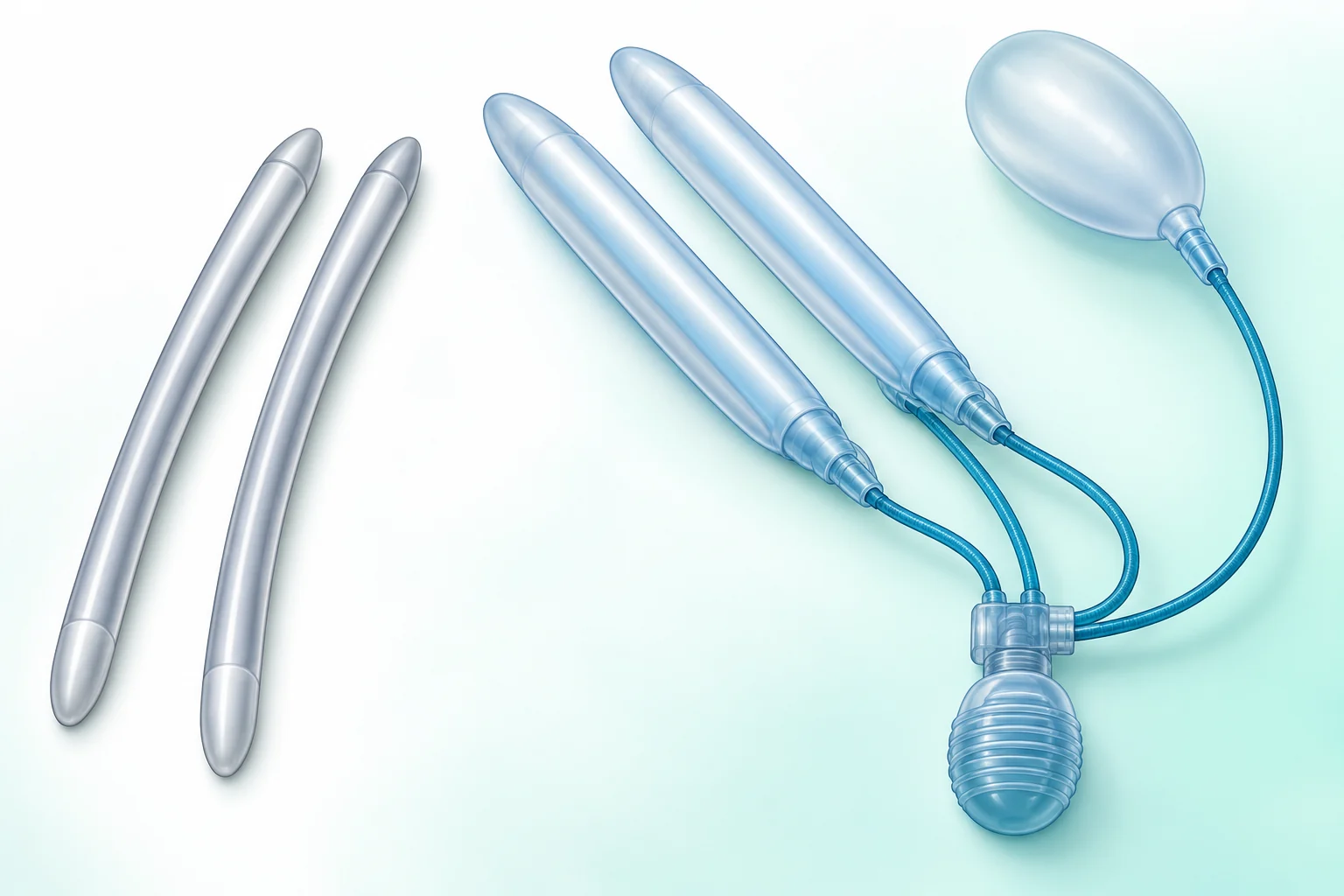
The two main types are bendable semi-rigid implants and inflatable implants, often called hydraulic implants. According to Mayo Clinic, preferences and medical history influence selection.
Malleable
- Manual positioning
- Continuous rigidity
- Simpler operation
Inflatable
- Pump control
- Inflation and deflation
- Requires the ability to operate the device
Is an inflatable implant better for every patient?
No. The doctor discusses your ability to use the device, previous operations, general health and preferences. Malleable implants are simpler to operate, but continuous rigidity may make concealment harder. Inflatable systems have two or three components; the brand name alone is not a selection criterion.
Benefits, risks and expectations
The purpose of an implant is to support rigidity, not to enlarge the penis or guarantee marital happiness. Risks include infection, device problems and tissue complications, and further surgery may be needed. Discuss the risks, recovery and follow-up plan for your case. No outcome is guaranteed.
How should you prepare for the consultation?
Choose an in-clinic assessment or an online consultation with Dr. Maher Moazin to discuss your case, then prepare the following:
- Bring a list of medications, operations and previous reports.
- Record the treatments you have tried and your response to them.
- Ask about alternatives, your individual risks and follow-up.
- Discuss your expectations and ask for an explanation of device use.
Frequently asked questions
Are implants suitable for every case of erectile dysfunction?
No. Medical assessment and discussion of alternatives determine suitability.
Is an implant intended to enlarge the penis?
No. Its therapeutic purpose is to support rigidity, without a promise of increased size.
Is it visible outside the body?
The components are implanted inside the body. Concealment differs between types.
When can sexual activity resume?
After your surgeon approves it according to healing and the recovery plan. Do not activate the device early on your own.
How much does surgery cost in Saudi Arabia?
Cost varies with the device, facility and individual case. Request a written quotation covering follow-up and additional expenses.
How should I choose a doctor?
Check licensing, experience, clear explanations of alternatives and risks, and follow-up. Promotional superlatives alone do not establish care quality.
Start by understanding your condition
Explore Dr. Maher Moazin’s professional experience, read the penile implant service guide, then book a specialist assessment. A consultation does not commit you to surgery.